MiSTer DE1-SoC
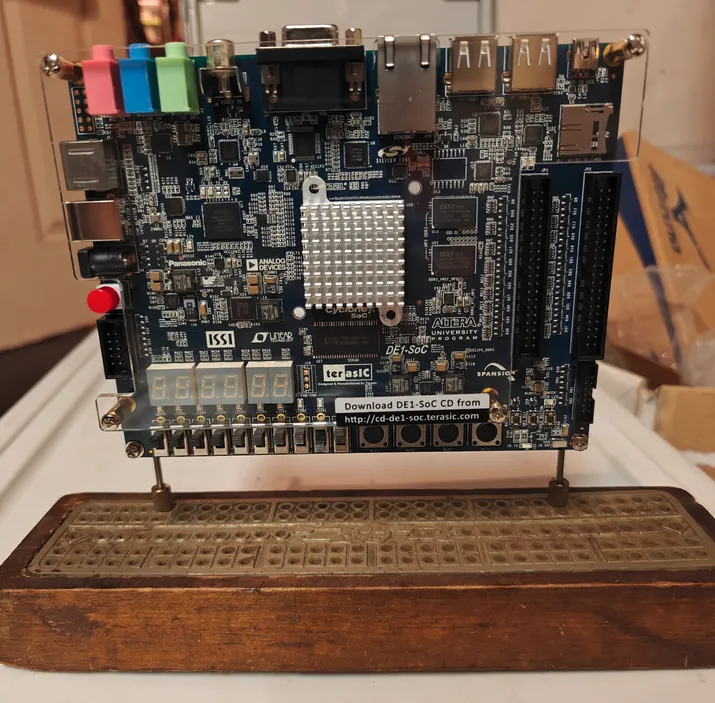
The board is propped up on a wooden stand stamped “PAT. SEPT. 1, 1885.” An 1885 patent holding a 2015 FPGA that’s running a 1991 Sonic the Hedgehog. Three centuries of engineering, none of them talking to each other, all of them working.
The Terasic DE1-SoC is a Cyclone V FPGA development board — the kind universities buy in bulk for digital logic courses, the kind that spends most of its life in an anti-static bag in a cabinet. Students use them for one lab and move on. I found two in the ewaste scrap pile.
The MiSTer project turned the DE10-Nano — a different Terasic board — into a legitimate retro gaming platform. Hardware-level emulation via FPGA, not software approximation. The community built cores for dozens of systems: SNES, Genesis, NeoGeo, ao486, Amiga, the list keeps going. It’s one of the best things happening in retro gaming preservation.
But the DE1-SoC isn’t a DE10-Nano. Different FPGA silicon. Different pin mappings. Bitstreams aren’t interchangeable. A small group at MiSTer-DE1-SoC ported a handful of cores to the DE1-SoC — and then went quiet around early 2020. The repos are still there. The code still compiles. Nobody’s home.
Getting it running
The setup is deceptively simple if you know where the landmines are. Flash an SD card with the right partition layout, copy files in the right order — MiSTer.ini before the MiSTer binary, because they share the same 8.3 FAT name and the old kernel resolves on first-found — set the DIP switches to the zig-zag pattern (ON OFF ON OFF ON OFF, non-negotiable), plug in VGA and a USB keyboard, and power it on.
VGA only. No HDMI. The DE1-SoC has an ADV7123 DAC that outputs analog video, and you need forced_scandoubler=1 to get a standard monitor to display anything — it doubles the 240p output to 480p. There’s some static on the menu screen that might be a DAC characteristic or might be a DIP switch tuning issue. Either way, it disappears when a core loads.
12V barrel power, not the 5V USB the DE10-Nano uses. The FPGA runs hot. A heatsink helps.
What works
SNES, Genesis, C64, Atari 2600 — all confirmed running with ROMs loaded through the OSD. Mario Collection on SNES. Sonic on Genesis. The C64 drops to a BASIC prompt and accepts keyboard input, which is exactly the kind of thing that makes you feel something you can’t quite name. USB gamepads map through the OSD menu. SSH works over ethernet for those moments when you need to poke at a retro gaming console from across the room.
The ao486 core is staged — BIOS downloaded, empty VHD created, FreeDOS ready to install. Doom on FPGA hardware is the obvious next step. An OLED status display is scripted but untested. Bluetooth controllers are theoretically possible.
A preservation project
The DE1-SoC port is frozen at 2020 binaries. There is no upstream to track. The repos haven’t been archived — they’re just quiet, the way open source projects go quiet when the maintainers graduate or get jobs or have kids or just move on.
This isn’t an active development target. It’s a preservation project — keeping hardware running that someone else made work, on a board that was never supposed to end up here. The flash script, the configs, the documentation of which DIP switches do what and why the copy order matters — that’s the contribution. Making sure the next person who finds a DE1-SoC in a cabinet can get it playing games in an afternoon instead of a weekend.
The programmable chip that was supposed to teach digital logic is instead playing Sonic, mounted on a cribbage board older than bottle caps and shredded wheat.